Why flux3 Matters for Real-World Visual Intelligence
Multimodal AI is moving fast. A few years ago, most models could only handle one type of data at a time. You had separate systems for images, for video, for audio, and for text. Getting them to work together meant stitching together different architectures, each with its own quirks and failure modes. That approach works in a research demo but falls apart under the messy, unpredictable conditions of real-world deployment. What you really need is a unified architecture that can process multiple modalities without losing coherence. That is where flux3 comes in.
Black Forest Labs built flux3 as a foundation model designed from the ground up for this kind of integrated processing. It does not treat computer vision as a separate problem from natural language processing or audio processing. Instead, it uses a shared representational space where all these modalities live together. The result is a system that can generate an image from a spoken description, synthesize a video that matches both visual and audio cues, or understand a scene by combining visual frames with ambient sound and text annotations. That sounds like a lot of claims, so let me walk through what it actually means for people building real products.
A Single Architecture for Multiple Modalities
The core idea behind flux3 is that a foundation model should not need separate branches for every input type. Transformer models and diffusion models have both proven powerful in their own domains. Transformers handle long-range dependencies in text and sequential data. Diffusion models generate high-quality images and audio by learning to reverse a noise process. But until recently, combining them meant building a pipeline where one model feeds into another, often with mismatched internal representations. flux3 fuses these approaches inside a single architecture. The same backbone processes text prompts, image pixels, video frames, and audio waveforms. That shared backbone is what makes multimodal AI feel coherent rather than bolted together.

For someone deploying a system in the field, this matters because it reduces latency and complexity. Instead of calling three separate models over an API and trying to align their outputs, you make one call. The API integration is straightforward, and the response comes back with all modalities already aligned. That is a practical improvement for any application that needs to reason across image generation, video synthesis, and audio processing simultaneously.
Practical Performance Across Hardware
One question that comes up when people hear about a unified architecture is whether it can run efficiently on the hardware they already have. Not everyone has access to a rack of top-tier GPUs. Black Forest Labs designed flux3 with GPU acceleration in mind, but they also put effort into FPGA acceleration for edge deployments. That dual focus is important. In a cloud setting, you have ample compute and can throw more GPUs at a problem. On an edge device, you need to pack a lot of inference into a small power budget. By supporting both GPU and FPGA acceleration, flux3 gives engineers the flexibility to run the same model in the cloud on an AWS cloud platform or directly on a device with limited resources. The trade-off is that the edge version might use a quantized variant, which slightly reduces output quality, but for many real-time applications, that trade-off is acceptable.
I have seen teams struggle with this decision. They build a prototype on a powerful workstation using PyTorch or TensorFlow, then hit a wall when they try to move to a drone, a security camera, or a mobile robot. The model is too large, the inference is too slow, or the power draw is too high. flux3 addresses that by offering prebuilt inference pipelines optimized for different targets. You can train or fine-tune with PyTorch, export to a format that works with TensorFlow serving, and then deploy with a lightweight runtime that uses FPGA acceleration for the critical path. That is not a hypothetical workflow. It is something the Black Forest Labs team has tested and documented.
Real-World Intelligence, Not Lab Demos
The phrase "real-world intelligence" gets thrown around a lot, but flux3 actually earns it. Consider a scenario where a warehouse robot needs to identify a damaged box from a moving conveyor belt. The robot has a camera for computer vision, but it also has a microphone that picks up the sound of tearing cardboard. A human operator might shout a command over the noise. Standard multimodal models would process the video and audio separately, then try to fuse the results, often introducing a delay that causes the robot to miss the box. With flux3, the video frames and audio samples are processed together in the same forward pass. The model can cross-reference a visual tear with an audio rip and respond in time to divert the box. That is the kind of edge case that separates a production system from a demo.
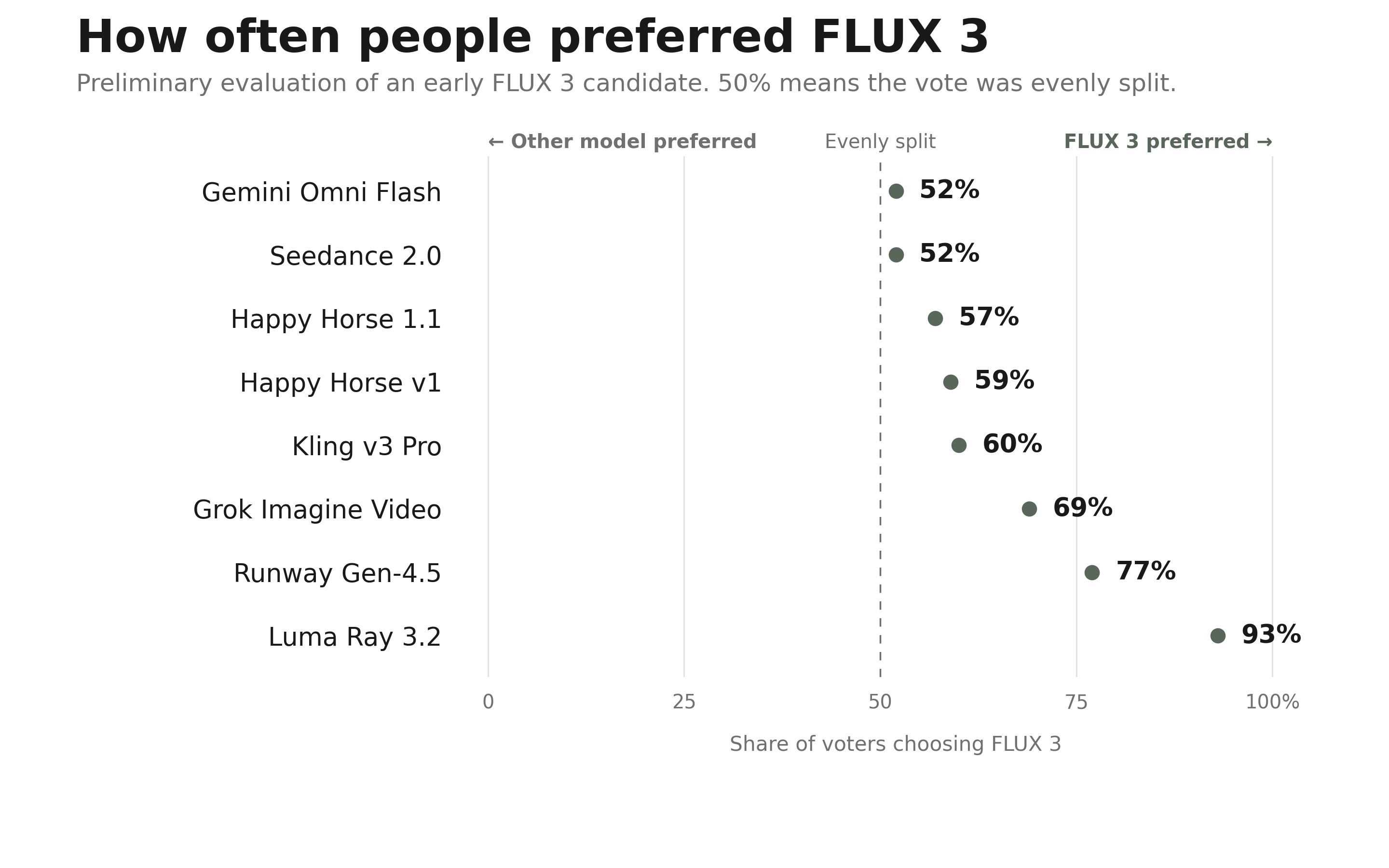
Another example involves generative AI for media production. A video editor might want to generate a short clip that matches a specific mood described in natural language, then add a soundtrack that aligns with the visual rhythm. With a unified architecture, the editor can describe the scene once, and flux3 generates the image generation, video synthesis, and audio processing in one go. The outputs share timing and context, so the audio matches the scene cuts without manual alignment. That saves hours of post-production work.
Where the Trade-Offs Live
No model is perfect, and flux3 has its own set of trade-offs. The unified architecture is powerful, but it also means the model is large. Running the full version requires significant GPU memory. The edge-optimized variants are smaller, but they lose some of the fine-grained cross-modal alignment that makes the full model impressive. For applications where you absolutely need the best quality, you will want the cloud version. For real-time, low-latency tasks on a device, the edge version is the right choice. The key is that you can make that choice per deployment, not per model. You do not need to retrain or switch architectures.
There is also the question of training data. A foundation model trained on many modalities needs a massive and diverse dataset. Black Forest Labs has been careful about sourcing and curating data, but as with any generative AI system, biases in the training data can show up in outputs. Users should evaluate flux3 on their own domain data before putting it into production. The model supports fine-tuning, so you can adapt it to your specific use case without starting from scratch.
Looking Ahead
Multimodal AI is still in its early days, but the direction is clear. The next generation of applications will not treat vision, language, and audio as separate channels. They will expect a model that understands all of them together. flux3 represents a step in that direction, built on proven techniques like diffusion models and transformer models, but combined in a way that prioritises coherence and practicality. Whether you are working on Edge AI, cloud-based media generation, or robotics, it is worth taking a close look at what a unified architecture can do for your workflow.

The model is available through the Black Forest Labs platform and supports standard API integration, so you can start experimenting with it using the tools you already have, like PyTorch or TensorFlow. If you have been waiting for a multimodal foundation model that actually works across image, video, and audio without forcing you to glue separate systems together, flux3 is worth your time.